
Third-party dated reputation readings rechecked 27 August 2026
Kong Casino Reputation & Reviews: Player Feedback vs Confirmed Facts
 Available in GB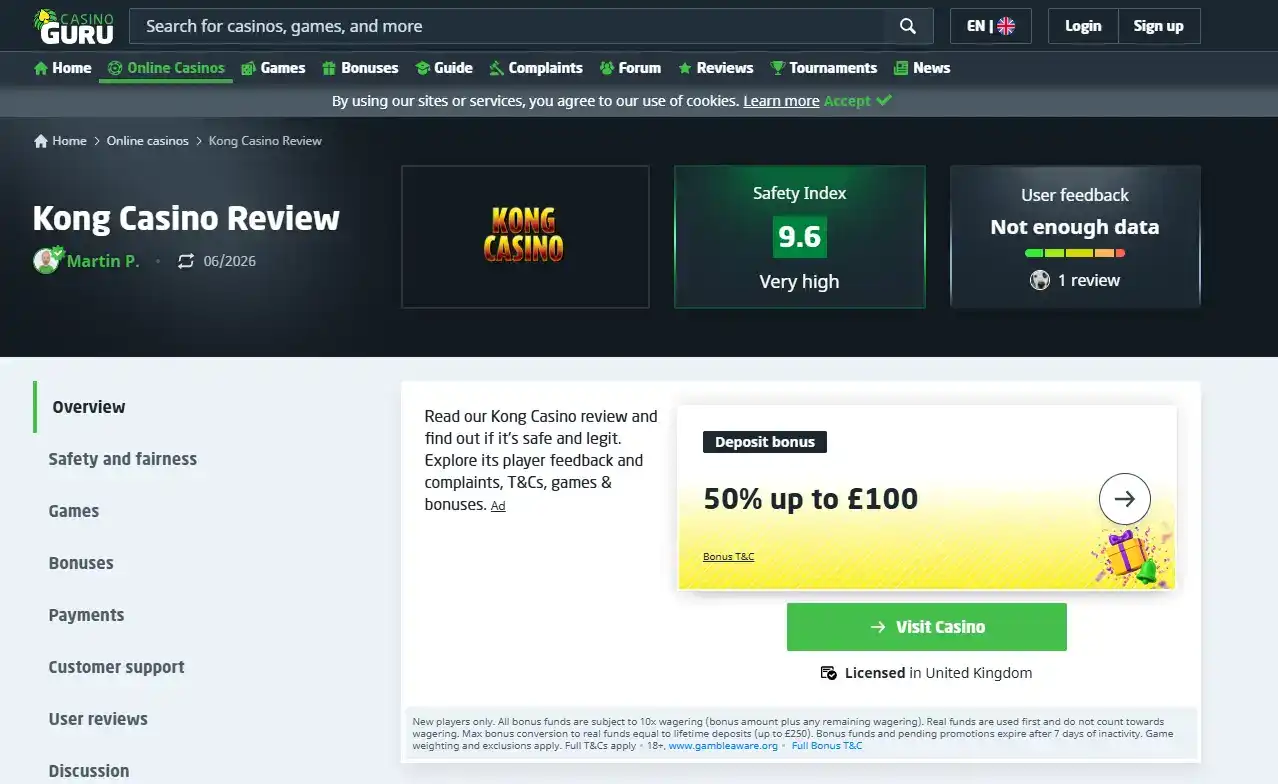
As of 27 August 2026, Kong Casino’s Trustpilot profile displays a 1.7/5 TrustScore from 145 reviews. Casino Guru’s Kong Casino review displays a 9.6/10 Safety Index labelled “Very high”, last updated in June 2026. Those numbers look contradictory only if they are treated as measurements of the same thing. They are not.
Trustpilot is a user-review platform reflecting submitted customer feedback and its own scoring system. Casino Guru’s Safety Index is an editorial methodology built from factors such as terms, complaints, estimated revenues, blacklists and related casinos. Neither score is a Gambling Commission rating, and this page does not average them into a synthetic score.
- Kong Casino review reading on 27 August 2026
- What the Trustpilot reading says
- Why Casino Guru can show 9.6/10 at the same time
- Ratings are not licensing evidence
- How to cross-check withdrawal complaints
- How to cross-check KYC complaints
- When a bad review should become a formal complaint
- A better way to read casino reviews
- What reputation scores do not tell you about product fit
- Sample size and representativeness matter
- Which signal should win when sources disagree?
- Kong Casino reputation verdict
Kong Casino review reading on 27 August 2026
| Source | Dated reading | What the number represents |
|---|---|---|
| Trustpilot | 1.7/5 from 145 reviews | User-review sentiment processed through Trustpilot’s TrustScore system. |
| Casino Guru | 9.6/10, “Very high”, updated 06/2026 | Casino Guru’s own Safety Index methodology, not a regulator score. |
The date matters because both pages can change. New reviews can alter the Trustpilot score and count. Casino Guru can update its review, methodology inputs or Safety Index. A reputation page that copies a score without a date quickly becomes misleading even if it was accurate when written.
What the Trustpilot reading says
The current Trustpilot profile shows 145 reviews and a 1.7 TrustScore. Its visible rating distribution is heavily negative: 78% of reviews are shown as 1-star, while 8% are 5-star, 4% are 4-star, 6% are 3-star and 4% are 2-star. Trustpilot also displays its own context note that the company has no recent history of asking for reviews, so the reviews may not be representative, and says the company has not replied to negative reviews.
Those are platform-level observations, not findings that every customer will have the same experience. The individual reviews visible on the page include negative accounts involving withdrawals, communication and identity checks, but also positive accounts describing successful withdrawals. They are anecdotes written by individual users. They can identify issues worth checking, but they do not establish a general operational fact by themselves.
This distinction is especially important for a low user-review score. A reader can reasonably treat the score as a warning to investigate service experience more closely, but should not convert an individual review into a claim such as “Kong never pays withdrawals” or “Kong always delays KYC”.
Why Casino Guru can show 9.6/10 at the same time
Casino Guru’s page labels Kong Casino’s Safety Index 9.6 and “Very high” and dates the review update to June 2026. On the same page, user feedback is marked “Not enough data” with one review. That alone shows that the 9.6 is not a large-sample customer-satisfaction score.
Casino Guru explains that its Safety Index draws on its review methodology, including terms and conditions, player complaints, estimated revenues, blacklists and other factors. It also says Kong is related to 52 other casinos and that related-casino information is factored into the Safety Index. The resulting number therefore reflects Casino Guru’s model and data choices, not just direct Kong customer ratings.
A high Safety Index can coexist with poor Trustpilot sentiment because the two systems weight different evidence. One asks, in effect, how users who posted reviews rate their experience. The other asks how the casino scores under an editorial risk methodology. Treating the two numbers as competing votes on one universal scale would erase that difference.
Ratings are not licensing evidence
For a hard operator check, use the Gambling Commission rather than either review platform. The current UKGC register identifies Jumpman Gaming Limited under account 39175, shows active Remote Casino activity under identifier 039175-R-319452-025 and lists kongcasino.com as a White Label domain under the account.
Those are register facts. They are not boosted by Casino Guru’s 9.6 and they are not cancelled by Trustpilot’s 1.7. The licence and safety page explains the operator linkage, Great Britain scope, customer-funds protection and historical enforcement context in detail. The licence behind the brand is on the trust page.
This is the first rule for interpreting reputation: use reviews to investigate experience and use the regulator to verify licensing. Mixing those functions produces both false reassurance and false alarm.
How to cross-check withdrawal complaints
Withdrawal complaints are useful search prompts because payout speed is a common source of frustration. They are not a substitute for the official withdrawal rules. Kong’s current material confirms a 72-hour internal pending period, but its official FAQ and Terms conflict on the post-pending delivery window: one gives 1-3 working days and the other 1-5 working days.
That official conflict is more precise than selecting whichever review anecdote sounds typical. If a reviewer says a payout took a particular number of days, that describes one case. If an official page gives a published process, it describes the operator’s stated rule. When the official pages themselves conflict, the correct response is to preserve the conflict rather than invent one definitive delivery time.
The payout guide separates the pending period, post-pending banking time and KYC checks so review anecdotes can be compared with the actual published process.
How to cross-check KYC complaints
Kong’s current FAQ gives a concrete verification workflow: photo ID, recent proof of address and payment-method evidence when requested, with up to three working days of guidance for manually uploaded documents. Great Britain rules separately require remote licensees to verify core identity information before allowing a customer to gamble.
If a review reports an identity-check delay, the useful questions are therefore specific. Was the account asking for an initial identity check, a later due-diligence check or a resubmission after a document was declined? Was the published manual-review window exceeded? Was a withdrawal also pending? Those details matter more than treating “KYC problem” as a single category.
Anecdotal complaints can expose where the customer experience feels difficult, but official workflow evidence gives the benchmark for what the process is supposed to require.
When a bad review should become a formal complaint
Leaving a public review and making a formal complaint are different actions. A review communicates experience to other consumers. A formal complaint enters the operator’s dispute process and, for eligible unresolved UK disputes, can lead to eCOGRA Alternative Dispute Resolution after deadlock or the eight-week threshold described in Kong’s terms.
If the goal is to obtain a decision on an account issue, save evidence and use the formal route rather than relying only on a review platform. The complaints process page covers the escalation steps. Trustpilot or Casino Guru can still help you see how other users describe service, but neither platform replaces the contractual dispute mechanism.
A better way to read casino reviews
- Date the score. Dynamic ratings are dated readings, not permanent facts.
- Identify the measurement. Ask whether the number is user sentiment, an editorial methodology or a regulator status.
- Separate anecdotes from repeatable facts. One complaint can be important without proving a universal pattern.
- Cross-check high-impact claims. Licensing, withdrawal rules and KYC requirements should be checked against official sources.
- Do not average incompatible scores. A 1.7/5 user score and a 9.6/10 safety index do not become a meaningful midpoint.
This method also applies to positive reviews. A fast payout described by one customer does not guarantee the same time for another account. Likewise, a third-party site’s high safety score does not override the operator’s actual terms or regulator record.
What reputation scores do not tell you about product fit
Neither Trustpilot’s score nor Casino Guru’s Safety Index answers whether Kong’s current game library fits your preferences. Product fit is a separate decision involving game types, providers, live casino availability and the titles you actually want to play. The Kong Casino games guide deals with that catalogue question.
This separation matters because a casino can have a strong or weak reputation signal while still having a game range that is personally attractive or irrelevant. A useful review process checks licensing, operations, reputation and product fit as separate dimensions rather than asking one score to answer everything.
Sample size and representativeness matter
Trustpilot’s 145-review total is large enough to be a visible consumer signal, but it is not the same as a random survey of all Kong customers. Trustpilot itself warns on the profile that the company has no recent history of asking for reviews and that the reviews may not be representative. That context should stay attached to the score instead of being dropped when the 1.7 figure is quoted elsewhere.
Casino Guru has the opposite-looking problem on its own user-feedback field: the page says there is not enough user data and shows one review, while the editorial Safety Index is still 9.6. This makes the methodology distinction concrete. The Safety Index is not high because a large body of Kong users gave it 9.6; it is high because Casino Guru’s own model evaluates a different evidence set.
The most defensible interpretation is therefore two-dimensional. Trustpilot supplies a materially negative user-review reading with a platform caveat about representativeness. Casino Guru supplies a materially positive editorial safety assessment with limited direct user feedback on its own page. Neither dimension should be hidden to make the reputation story simpler.
Which signal should win when sources disagree?
There is no single source that should “win” every question. For licensing, the regulator register outranks review platforms. For the operator’s published withdrawal or verification process, current official terms and FAQs are the primary benchmark. For customer sentiment, review platforms are relevant precisely because they collect experience reports that official pages do not.
When sources disagree about the same factual rule, preserve the conflict or prefer the stronger primary source. When sources measure different things, do not call it a factual conflict at all. Trustpilot’s 1.7 and Casino Guru’s 9.6 are an example of different measurements, not two competing answers to one survey question.
This evidence-order approach is also why this guide does not use the low Trustpilot score to rewrite confirmed licence facts, and does not use the high Casino Guru index to dismiss customer complaints. Each signal remains in the lane where it provides information.
Kong Casino reputation verdict
The current public reputation picture is sharply split. Trustpilot shows a low 1.7/5 TrustScore from 145 reviews on 27 August 2026, with a heavily negative star distribution. Casino Guru shows a 9.6/10 “Very high” Safety Index from its June 2026 update while also saying direct user feedback on its own page is insufficient.
The split is not solved by picking the higher or lower number. Trustpilot is primarily a user-review signal; Casino Guru’s Safety Index is an editorial risk model. Neither is a regulator rating. Negative review anecdotes are useful prompts to check withdrawals, verification and support, but they remain individual experiences until stronger evidence supports a general claim.
For a decision, combine these dated reputation signals with current UKGC evidence, the operator’s official terms and the specific feature you care about. The full Kong Casino review provides that wider context without manufacturing a single composite score. The full picture is in the Kong Casino review for UK players.
Published by the Kong Casino team.